API quota exceeded. You can make 500 requests per day.
A Colorbond fence can look simple from the road. After that you step onto the home line and realize it is a work built on little decisions: where the fence really requires to rest, what the ground will do after rain, just how you deal with a leaning article base, and whether the gates will relocate freely for several years. I have actually constructed enough Colorbond fencing to recognize the difference between a fence that looks fantastic on mount day and one that still does when the seasons have done their work.
This is the complete walkthrough of just how a Colorbond fencing builder comes close to the task, from initial website preparation via last handover, what to anticipate, and where individuals usually get surprised.
Start with the ideal question, not the first post
Before any individual raises a post, you want quality on the limits, the objective of the fence, and the real-world format. A Colorbond fence builder who hurries to "place it where the illustration states" is setting you up for an agonizing improvement later.
On many jobs, the border line is not as clean as house owners think. Survey marks can be covered by gardens, a previous paling fencing might have wandered over time, or the "edge" someone indicate is in fact a couple of levels off. In technique, we verify the line with measurements that connect back to a reference factor on site. That might be a building edge, a legal survey peg, a driveway side, or a masonry feature that has not moved.
Then there's the intent. Are you going for personal privacy, sound decrease, safety, wind resistance, pool conformity, or every one of the above? Colorbond fence alternatives let you call in height and paneling design, however the construct technique still matters. Wind load, for instance, is not theoretical. If you have actually obtained exposure on a corner great deal, we construct for it. If the fencing backs onto a backyard with large trees, we prepare for the means particles and branches will certainly influence lower rails and blog post faces.
I have actually strolled tasks where the proprietor assumed they were acquiring "simply a fencing," after that a week later they were inquiring about incline transitions and why the bottom colorbond fencing panels supplier clearance adjustments near a driveway. That's the moment you find out a correct Colorbond fencing installer treats the site conditions as component of the design.
Permissions, neighbors, and the documentation that saves debates later
Even when you don't require major council authorizations, you may need conformity steps. Some locations have fencing height guidelines, limit placement guidelines, or limitations for front obstacles. If you're within a regulated zone, you don't desire guesswork.
A professional Colorbond fencing company will generally request for the basics early: building details, any kind of existing easements, and where the fence is meant. If there's a limit disagreement, the most awful time to figure out is after concrete has actually set and panels have actually been cut to shape.
The useful method I suggest is basic: verify that needs to accept the positioning, validate the desired elevation, and record the concurred placement. If there's any neighbour participation, it deserves communicating very early and plainly. Even a friendly chat can prevent the "we believed it was implied to be over there" minute later.
Site study and setout: where the job is won or lost
Setout is where most time vanishes if it's done properly, and where most revamp is produced if it's rushed.
The goal is to develop the fencing line so posts enter the best area, in the right order, with regular spacing. You're taking care of corners, reversals, and usually subtle slope or uneven ground. We take some time to mark out the line, look for offsets, and map out exactly how the fencing will follow the terrain.
On a typical Colorbond fence, blog posts are the structural system. If the posts are incorrect by a percentage, the rails and panels will certainly require themselves into uncomfortable placements. That can result in visible misalignment, stretched fittings, and a fence that doesn't sit as cleanly as you paid for.
Here's a reality check I've seen continuously: also if the ground looks degree from the back fence, it can drop or increase enough to affect the fencing bottom line. With Colorbond fencing, you can take care of some variation by design, however you still need to prepare the technique prior to you start piercing. Otherwise you end up with consistent small adjustments that eventually show up as irregular visual lines.
Clearing and preparing the ground without damaging what matters
Once setout is confirmed, the site preparation starts. Clearing appears easy up until you factor in root systems, existing drainage, and services.
We generally get rid of plants along the prepared fence line to permit secure work and clear gain access to for digging and installment. Yet we do it with an eye on what is not expected to be interrupted. Tree roots can be challenging to remove easily, and excavating also close can cause unexpected negotiation or compromise stability. If there are irrigation lines, power channels, or stormwater attributes near the line, preparation consists of identifying them, not guessing.
If the property has rocks, fill dirt, or a mix of products, we adjust. Some ground types hold article openings well for some time and afterwards shift somewhat as the dirt compacts or holds wetness in a different way. In those cases, concrete and the means it is positioned issue. The "looks penalty when it's established" issue can show up months later on when seasonal wetting and drying out adjustments the ground.
I've also seen individuals attempt to manage site prep themselves, then call a Colorbond fencing installer just as soon as panels and rails are currently on website. That's normally much more expensive than doing it effectively in advance. A home builder's work gets harder when accessibility is inadequate, particles is left in the trench, or post openings are unequal comprehensive due to the fact that someone guessed where the rock started.
Digging article openings: placement, depth, and stability
Post holes are not just openings. They are structural points that identify just how the entire fence behaves under wind and just how it stays right over time.
A good Colorbond fence builder will certainly set constant hole positioning and plan deepness based on ground problems and exposure. Also shallow, and you take the chance of movement. Too deep without proper control can be a mess if you hit voids or loose product. The method is to match depth and approach to the dirt you're actually dealing with.
We additionally consider water. Poor water drainage around a blog post can maintain the base saturated, which can affect security. When soil is mixed with clay, sand, or fabricated fill, the blog post opening can behave in different ways than you expect simply by considering the surface.
A detail that matters more than people think is just how the hole is completed before concrete. We eliminate loose spoil, make certain the base is firm sufficient for the concrete to bond effectively, and set the message with appropriate positioning. Then we keep it consistent up until the concrete starts to hold. You can not "eyeball and hope" and anticipate lasting straightness.
Posts and supporting: the straight-line insurance coverage policy
Colorbond secure fencing depends on posts, rails, and the cladding system to collaborate. If the blog post lines are slightly off at the start, the rails will either look wavy or the panels will certainly end up under tension. In any case, the fencing becomes a stress and anxiety story.
Bracing throughout install is just one of those unglamorous steps that makes the completed outcome appearance effortless. When messages are plumb and braced, rails go on without battling. Gates relocate extra smoothly due to the fact that the structure is built square.
I've built fences where the ground was flexible and whatever "mosted likely to strategy." I've additionally constructed fences where the dirt was a patchwork, and the only method to obtain a clean fence line was to change post positioning within the accepted design and take additional treatment with setting. Those work take patience, however completion result is solid.
Rails and panel installment: exactly how tidy lines are achieved
Once messages are set, rails typically go in next, after that panels. Yet excellent building contractors don't treat it like a production line. They make up thermal movement, panel fit, and the means the fence fulfills edges and boundaries.
With Colorbond fence installations, constant rail height is a huge component of the look. Panels are designed to rest neatly when the rail positioning is correct. If a rail is a few millimetres off throughout several bays, it can become a noticeable action throughout a long run.
Panels also need to be dealt with correctly at cuts and corners. Cutting is not just trimming. It has to do with maintaining a clean edge profile so the panel sits correctly and doesn't grab during attachment. Where the fence changes instructions, we examine that the transition is square sufficient to look deliberate, not like an improvised corner.
And after that there's wind. Panels act like sails when air flow hits the face. A Colorbond fencing installer should bear in mind exactly how the fence is supported and fastened, particularly on the first area installed. If you're working in subjected conditions, short-term security while the concrete remedies can matter.
Working with slopes and uneven ground, without making the fencing look "patched"
Most residential properties have some slope, even if it's refined. The question is how you manage it aesthetically and structurally.
You might see a fencing with a smooth "tipped" appearance, or a fence with a constant profits that adheres to the contour. Each technique modifications just how the panels rest and how clearance operates at the base. If you have drainage lines, yard beds, or areas where you require air flow and maintenance access, the layout decision matters.
The incorrect strategy creates gaps that accumulate fallen leaves or develop tripping dangers in high-traffic locations. It likewise makes cleaning harder. A fencing that is set up carefully will have a neat base line and constant bay appearance.
In some jobs, we make use of ground-level changes, in others we take into consideration the shift height. What I won't do is compel panels to look uniform by flexing or over-tightening fittings, due to the fact that you can trade short-term cosmetics for lasting looseness.
Gates: the component everybody utilizes, and every person notices
Gates are where handiwork ends up being apparent. People may not look very closely at every bay day one, but they will observe if a gate scrapes, droops, or does not latch properly.
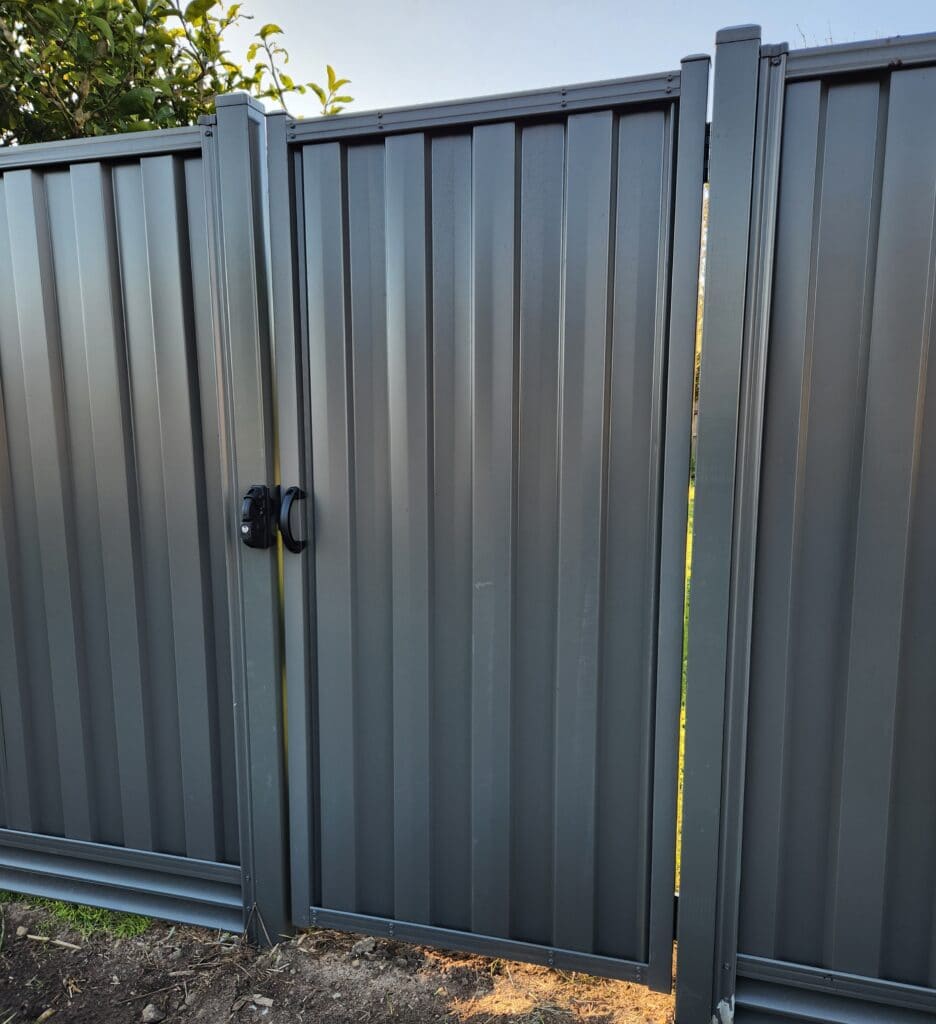
A Colorbond fencing company that develops entrances correctly starts with exact framing placement and correct clearance. The gate pivots require a strong mounting surface area, and the gate needs to be square so it swings without binding.
A detail that gets missed on some installs is exactly how gateways communicate with articles. If post placements drift, entrance framework positioning adjustments. Also a small change can cause the lock to sit off-line or need pressure to close.
I have actually had house owners inform me their gateway "used to shut great" and then the fence "simply changed." Generally the real tale is that the base negotiation or post motion changed the geometry. That's why good footing prep and bracing isn't optional, specifically in windy locations or where dirt is soft.
Corners, joints, and exactly how the fence fulfills the remainder of the property
The fencing hardly ever exists alone. It meets home wall surfaces, brickwork, driveways, preserving frameworks, and occasionally other fencings or entrances currently on website. These junctions develop difficult lines.
A builder has to decide just how to shift products cleanly. That might entail trimming panels specifically, suitable capping and edge details correctly, and ensuring the fencing line does not create pinch factors at the edges. It also includes managing where the fence intersects with existing structures so water runs off properly rather than pooling at junctions.
A neat junction appears like it was always implied to be there. A careless one appears like a patch.
The completing stage: caps, trims, and where rust control matters
Finishing is not just visual. It's functional. Where steel satisfies wetness, the right components and appropriate attaching methods issue for long-term performance.
Colorbond steel is created to handle weather condition exposure, but the task still needs care in just how whatever is mounted. Caps and trims keep water relocating far from crucial areas. Bolts need to be appropriate for the system and installed effectively. Missing an information can produce corrosion paths or spots over time.
We likewise tidy up as we go. Steel offcuts, sharp sides, and debris can end up being a trouble. A professional Colorbond fencing builder maintains the site clean so the ended up fencing looks neat and safe.
If you have animals or children, the ending up information matter even more. Panels require to be safeguarded so they can not rattle. Gate locks ought to run efficiently, and areas where hands could get to need to be without harsh edges.
A fast, useful pre-install checklist (what you should verify prior to job starts)
If you're selecting Colorbond fence contractors or hiring a Colorbond fencing installer, these are the questions that stop migraines:
- Confirm the fence line and elevations are concurred in composing, consisting of exactly how the fencing will adhere to slope.
- Ask who takes care of site preparation and what is included, specifically getting rid of and message hole excavation.
- Get clearness on footing technique in your dirt type, including exactly how modifications are made if rock or soft ground is encountered.
- Confirm the materials and parts are part of the priced estimate Colorbond fence company range, not attachments.
- Ensure the beginning date and gain access to needs are realistic, including entrance clearance for machinery.
A good installer will certainly answer these without getting protective. If they're obscure or attempt to rush past them, that's your signal to slow down down.
Communication throughout develop: what a great builder does differently
One of the most noticeable distinctions between a typical fence mount and an excellent one is communication. Not consistent updates, but sincere, particular progress.
If we hit unanticipated ground conditions, we do not pretend they are typical. We explain what we discovered, exactly how it influences the develop, and what the adjustment will be. Sometimes that indicates revamping a post opening plan. In some cases it implies transforming a ground technique for security. In any case, you ought to understand what's taking place and why.
I remember a work where the ground near the corner was more challenging than expected and the intended footing deepness had to be changed. Completion result was great, however we had to move a couple of messages somewhat to maintain structural uniformity. The home owner valued it because we clarified the compromise ahead of time rather than "fixing it quietly" and wishing they would not notice.
A Colorbond fencing builder who has actually constructed hundreds of runs recognizes that the fence is a living framework in a living atmosphere. The build plan needs room for real site decisions.
Safety, debris administration, and safeguarding the property
Site security is non-negotiable. Fencing jobs entail tools, excavation, and heavy materials. A reliable Colorbond fencing installer establishes risk-free job practices and keeps the site managed. That consists of guaranteeing blog post holes are taken care of securely and debris is cleared properly.
Debris is greater than neat looks. Steel offcuts can be a puncture danger for footwear and tires. Concrete waste can obstruct drainage. Timber and product packaging can become a trip danger for children or installers working somewhere else on the property.
If the fence is going near gardens, building contractors need to safeguard existing plants or agree on what gets removed. An expert Colorbond fencing company will certainly coordinate with the house owner regarding what has to remain and what can be cleared for the installation footprint.
Final inspection: screening alignment and function prior to handover
Before we call it done, we do a detailed check. A fencing is "ended up" just when it acts appropriately and looks right, not when the last panel is bolted on.
We check line straightness by eye and by measurement. We evaluate gate procedure, including lock involvement and smooth swing. We make sure fasteners are safe and secure and the fence face rests continually across bays. We likewise evaluate the base line and shifts near inclines so the fence does not create odd gaps or squeeze points.
If there's any type of modification required, we manage it prior to leaving. The genuine price of blunders is not simply labour time, it's the home owner living with them every day.
Here's a simple handover strike list we make use of, due to the fact that tiny details often tend to obtain missed when everybody's weary:
- Confirm gateways lock smoothly and turn without rubbing.
- Check the fence line is straight and panel spacing is consistent across the run.
- Verify caps, trims, and corner information are installed cleanly without any sharp edges.
- Walk the size with the property owner and note any kind of agreed slope changes or joint finishes.
That last step matters. When you stroll it together, you capture what the homeowner anticipated, not simply what the installer thinks they built.
Handover files and what to maintain for the long term
A professional Colorbond fence company must supply you with straightforward documents. Relying on the job and regional needs, this can include a workmanship guarantee, product requirements, and any kind of setup keeps in mind pertinent to your site conditions.
Keep these documents. If you ever before require a repair work, the best details help the fixing process go quicker. Even when a fence is built well, life occurs. A gate could get struck by a trailer, branches could drop, or a brand-new yard bed may be included near the base. Recognizing the initial material system and installation approach makes future repairs simpler.
I have actually seen fence owners keep images from earlier phases of the construct, especially around message openings and rail positioning. It's not compulsory, yet it can be exceptionally useful if something ever before requires troubleshooting.
Maintenance that really makes good sense for Colorbond fencing
Colorbond fence is reduced maintenance compared to hardwood, however it still benefits from practical upkeep. Wind and weather condition move dust, leaves, and plant pollen onto surface areas. Salt air environments likewise demand attention, because deterioration control depends upon preventing long-term build-up.
Maintenance normally boils down to cleaning and monitoring. Try to find loosened bolts, unusual spaces around gates, and any kind of influence damage. If your fencing is exposed, take a fast walk after tornados. It is quicker to deal with a minor problem than to wait till it ends up being a visible placement problem.
When it's time to clean, prevent unpleasant techniques that can damage finishes. The objective is to remove grime securely and maintain the safety surface doing its job.
Choosing the ideal Colorbond fencing builder for your job
The finest sign of a strong Colorbond fencing installer is not just the pictures. It's how they talk about the information that matter: website setout, footing strategy, slope handling, gate positioning, and what occurs when truth varies from the plan.
A Colorbond fencing builder must fit clarifying compromises. If your website is tricky, you may need extra time for setout and bracing. If your dirt is soft, you may require a footing technique that costs a little bit more but avoids future movement. If the fence line is near an existing structure, you could need personalized junction trimming to keep it neat and weatherproof.
The right contractor does not offer you positive outlook. They offer you a process.
The genuine timeline from website prep to last handover
Every work differs based upon fencing length, gate intricacy, accessibility, and soil problems. Some fencings enter rapidly. Others take longer since the ground demands mindful footing job and setout adjustments.
But as a rule, the sequence corresponds: Website setout and preparation, article hole excavation and concrete setup, articles and rail setup, panel fitting, entrance construction and fitting, completing details, then last inspection and handover. When a home builder follows that sequence with perseverance, you obtain a fence that festinates and acts more than time.
If you are planning your setup, build organizing around the reality that treating time and weather conditions can impact concrete setup and final healthy modifications. A severe Colorbond fencing company makes up those truths rather than treating the project like a straightforward one-day job.
When the task is done, what you need to feel
A durable Colorbond fence need to feel solid. Panels should not rattle when a gate is slammed. Gates must gather self-confidence. Corners need to look intentional. The fence line must hold its appearance also after rain and minor ground movement.
Most home owners remember 2 points after handover: just how the fencing looks, and just how easily eviction functions. Whatever else, the straight line you don't knowingly discover, the base that doesn't move, the joints that remain tidy, comes from the unglamorous choices made during website preparation and installation.
That's what divides a Colorbond fence installer that just sets up, from a Colorbond fencing builder who builds.